Welcome to AnNisa Designs

Wednesday, June 19, 2013

Halal Beauty Products: Ultimate List!

From A Muslimah's Musing's

http://muslimahsmusings.blogspot.com/2011/07/halal-beauty-products-ultimate-list.html


بسم الله الرحمن الرحيم
In the name of Allah, Most Gracious, Most Merciful

I really feel that this post is long overdue. We all have our favourite brands of make up and skin care and such but do we ever check to see what is inside of them?

Many could ask; "Do we really have to go this far? We already have to check food labels so why do we have to check beauty product labels as well?" 

To cut a long story short - we are not allowed to eat pork in Islam, this is a ruling of Allah SWT. Therefore why should be be rubbing these lotions full of pig by-product into our skin which we purify before salah? Personally, it doesn't make sense. I feel that we go about using these products blinded and because we have so many resources now we shouldn't need to be supporting these deceitful companies anymore and can now support the ones who use pure ingredients inshallah. 

Please do not get confused and mistake this blog post as something which you could find from the "haram police". This is just my and many other Muslims views. Allah made us the only mammal who can think, listen, read, write and talk. It's about time we used our noggin and stopped being so lazy with the excuse of "it doesn't say that in The Quran".

Al-Quran is the best guide to all mankind however Allah SWT gave us a brain to use logic and to think outside the box with reason. You may wish to avoid some or all by-product ingredients, we all have different ethical values.

Another point to remember is that Allah does not allow animal cruelty. Therefore an animals welfare is far more superior than the workings of the latest mascara.

You may also like to watch this video about animal welfare in Islam which is inspired by our Prophet Muhammad (SAW) - don't worry there are no shocking pictures in it.

If you are curious to know why I used the above excuse as an example then please read on, if not just jump to the next paragraph inshallah :) I use "it doesn't say that in The Quran" as this is the response I got when I politely explained to a sister that M&Ms were not halal to eat due to their colouring (they contain E120 Cochineal which is a beetle, that is crushed to get the red dye from it making the red and oorange M&Ms - it's also in some red food colouring and marshmellows fyi). However I think she forgot to undertsand that Allah SWT only made the pure animals and meat allowed for us to eat. Is it just me or does anyone else see where I am coming from in this point? Just because it doesn't say it in black and white that M&Ms are not halal to eat doesn't mean that it isn't true. This is why I support people thinking outside of the box within reason, because Allah gave each of us a mind to think subhanallah. 


Alot of this research has come together from me taking time out and digging with my own two hands! It is great how easy it is to get the information too. Many websites will be happy to reply to your questions through email, some already have those questions answered on their FAQ page, many have the full ingredient list available on their website under individual products. I recently had someone ask how to get ahold of this information as they were doing research, I hope that helped you a little.

Check your own bathroom cupboard, make-up bag or dresser and read the labels.

You maybe thinking "I've read the labels but most of it is gibberish!"
This is very true, many companies are not going to list an ingredient called "pig fat", therefore they use 'Glycerin' or 'Sodium Tallowate'. 
NOTE: Glycerin can be taken from different animals or plants or vegetables - so before you disguard that product, double check to see which type of 'Glycerin' is used. If it is plant or vegetable then it is OK to use. 

All you need to do is search for each ingredient online, it is worth it in the end trust me! Here is a useful list of animal products to start you off. You could just need to check out your favourite products, rather than the whole range if you don't want to :)

And if you need to know who test on animals and who do not and you can't find the info on the company website:PETA are here to help! 

In 2009 there was a ban on animal testing in the EU for cosmetic ingredients, however that is only in the EU. Animal testing is still ongoing throughout the world. Our products come from large companies based all around where these rules do not apply. Not forgetting the possible loop holes that some companies may have found to continue testing on animals in the EU. Only Allah knows, but we can all do our bit inshallah!

Saturday, June 15, 2013

Highlighting Tayyibah Taylor, Editor - AZIZAH Magazine

INTERVIEW with ALTMUSLIMA
http://www.altmuslimah.com/b/reva/4735

Articulating the Muslim female experience: 
An interview with Tayyibah Taylor


Tayyibah Taylor is the founding editor-in-chief and publisher of Azizah Magazine, an award winning Muslim women’s magazine in its twelfth year of publication. Altmuslimah’s Sarah Farrukh asks Taylor about gender, Islam, the magazine’s vision, and violence against women in the Muslim community.


 Tell us about your experience with reconciling Islam and gender. 
Tayyibah Taylor: Before I converted [to Islam], I visited a mosque while I was in the Caribbean to listen to the Friday sermon. My cousin and I were the only women there. After it ended, all of the men stood up and started shouting, "What are these women doing in the masjid?" I thought, “I just want to find out about Islam!” It was as though we were violating the sanctity of the masjid by our very presence. But the violation was not one of piety. It was one of presence.

I also lived in Saudi Arabia for almost seven years. I realized there that the objectification of women is not always about being seen. For two of the years I was living there, I covered my face. On one occasion, I was getting off the bus and walking to my university’s gates, when I was accosted by men in several different cars. In the West the woman is undressed and her body is used to sell things. In Muslim-majority countries, she's covered up, barred from public space, and then when she enters this public space, she becomes objectified. The objectification is in such a different format, but the result is the same. So there was this kind of juxtaposition between wanting to be enveloped in spirituality in Islam and seeing this display of blatant gender inequality.

 Please share the story of how you founded Azizah Magazine.

Tayyibah Taylor: It had a subconscious start and a conscious start. I grew up in Toronto during a time when there were no positive images of people of color in the media, textbooks, or anywhere in the visible public space. When I was about 12, I remember picking up a copy of Ebony magazine, and seeing people of color in positions of leadership, contributing to society. And I had a bit of an epiphany in terms of validation of self, of being, of black culture.

The conscious start [to the magazine] took place in 1992, when the Sharifa Alkhateeeb created a conference for Muslim women in Chicago. They were from all across the country, of all ethnic backgrounds, and from all schools of Islamic thought. I remember going into the conference room and being mesmerized by the energy, the expertise, the beauty, and the spirituality that was in the room. And I said to myself: we have to encapsulate all of this, put this down in the pages of a magazine! I went back home, and started formulating the magazine’s concept. We launched the first issue in 2000.

 Tell us about Azizah Magazine’s approach to its portrayal of Muslim women.

Tayyibah Taylor: The magazine’s aim is to reflect who Muslim women in America are in their totality. So everything from food and fashion to books and travel, to more substantial issues, such as disability, eating disorders, and aging in the Muslim community is explored. It's about the totality of our existence because when we are looking to better ourselves, we don't look to develop just ourselves on a spiritual, professional, or artistic level. In order to respect your potential, you have to develop all aspects of your being. It's part of our ibadah—our worship.

 What can Muslim women do, on both an individual and institutional level, to create a meaningful and relatable reflection of themselves in mainstream publishing?

Tayyibah Taylor: I would advise women to fulfill whatever talent they have: whether it is being a fabulous mother and homeschooler or becoming a scientist for NASA. For those who want to write: it's important for us to tell our own stories. Usually, when we hear about Muslim women, someone else is having the conversation about us, or speaking to us. For example, when I first became Muslim, all the books about women I could find were written by men. Now, we have several Muslim women who have chosen Islamic theology as their field of scholarship, so we have books written by Muslim women about Muslim women.

So we are having our own conversation and it is rich with nuance, which makes it powerful and effective. And ultimately by writing our own stories, we are raising our God consciousness.

 You are a passionate advocate against gender-based violence. What is the core message you want to convey to audiences?

Tayyibah Taylor: To the female audience I say, "You are a khalif a fil ardh: a representative of Allah on this earth. You are not to be broken or beaten or abused. In many of Muslim-majority countries, misogyny has unfortunately been woven into the theology and practice of Islam, and then handed over as the original fabric of Islam. The subjected women are saying: "My mother was beaten. My sisters are beaten. This is my lot as Muslim woman, therefore I can't complain if my husband beats me.” There's menstruation, there's childbirth, there's abuse. It's just lumped into one inevitable experience.

Being able to separate what is cultural adulteration and what is Islam is essential. Both men and women are here on this earth for the purpose of worship. And we must point out to the men, “If we are all here to worship Allah, how can I have a soul that is completely at peace, pleasing to Allah, and pleased with Allah, if I'm in a state of constant fear and pain?

I also think that many times when women's groups go into Muslim majority countries or Muslim communities and try to undo some of the misogyny, they speak from a point of reference that is not inclusive of Islam. They approach Muslims from a very secular vantage point, or the Western feminist frame of reference. But I think it's important for us as Muslims to acknowledge that the Prophet Muhammad (peace be upon him) treated women with tremendous respect and dignity, and that is a model to be followed. It is a model that comes from our very own history. The change is not something you can superimpose on a person, a community or a country. They will embrace it if they feel they own it.

 How should Muslim women respond to the resistance they sometimes experience from their communities when trying to accomplish their goals? 

Tayyibah Taylor: When I first started Azizah Magazine, I got disgruntled calls, letters and emails from people saying "This is forbidden. You’re going to hell.” They asked me why I had women on the cover, suggesting that I should put pictures of food or flowers instead, to which I responded, “If this was a magazine about food, I would put food on the cover.”

That was 12 years ago. The community has come a long way since. The people who had defined the pious Muslim women as silent and invisible woman had problems--and still have problems—accepting a publication like Azizah Magazine, where the Muslim woman’s voice is unfiltered.

I think, however, that Muslim women’s modesty of dress and behavior is her passport to public space. It's not a reason to further bar her from public space. And I believe strongly that since our purpose as human beings is to worship if a Muslim woman’s intention is to praise God through her work, to establish a more connected Muslim community, or to help non-Muslims see Islam as it truly is, then who are we to say her work is not ibadah, worship?


Sarah Farrukh is an Associate Editor at Altmuslimah and an information studies graduate student at the University of Toronto. She blogs about faith and books at A Muslimah Writes.


Sunday, June 2, 2013

AnNisa Designs - Distinguishing Fashion for Women Who Cover

AnNisa Designs   Fashion for women who cover

annisadesigns.com

Bismillah

Highlighting the beauty of Islamic dress

I enjoy fashion – so much that I often search fashion sites online. Once while browsing the pages of Fashion Week, it starkly came to me that dress which covers is the most beautiful look on this planet. The flow of floor length grace is modestly intriguing. This demure presence so well accentuates the delicate form with which women are blessed.
\

Take charge of your expression

In observing and trying different fashion ideas, you’ve probably already seen that accessories can delicately enhance personal expression. And you possibly also realize that, with a few touches, you can uniquely convey your own personally distinguished virtue.


Like to see more?

Visit AnNisa Designs at www.annisadesigns.com. We believe our selections can bring your imagination into focus. Watch our video and view our approach to design. We are expanding and intend to represent many more choices. We therefore welcome your input as to the visual impressions you desire.

RAMADAN IS COMING 

Approaching The Holy Month always awakens my anxiety. Will I wake up in time make Fajr and eat before dawn? Will I prepare iftar well? Will I make each salat on time? And will reactions to fasting cause me to break my fast? I finally decided on assistance towards approaching  Ramadan with positive anticipation. If you are also observing Ramadan, the site listed has a series of duas, 1-30, for each day of Ramadan.  I look forward to each dua. Insha Allah you will also find them useful. http://www.duas.org/ramazan/Ramadhan30.htm

Wednesday, August 17, 2011

Fundamentally Why We Cover

"And say to the believing women that they should lower their gaze and guard their modesty; that they should not display theri beauty and ornaments except what (must ordinarily) appear thereof, that they should draw theri veils over their bosoms adn not display their beauty except to their husbands, tathers, husbands' fathers, sons, or their sisters' sons, or their women or the slaves whom their right hand possess or male servants free of physical needs, or small children who have no sence of the shame of sex; and that they should not strike their feet in order to draw attention to their hidden ornaments. And O ye Believers! Turn ye all together towards Allah(S.W.T) that ye may attain Bliss." (Al Qur'an 24:31)

Fashion Designer Rabia Z


Tuesday, August 9, 2011

How to Look Pretty and Cool in Hijab

Modest doesn't have to be unattractive or boring! Don't forget that the purpose of the Hijab is to protect your honour and beauty from unacceptable gazes. But, looking good is also part of Islam.


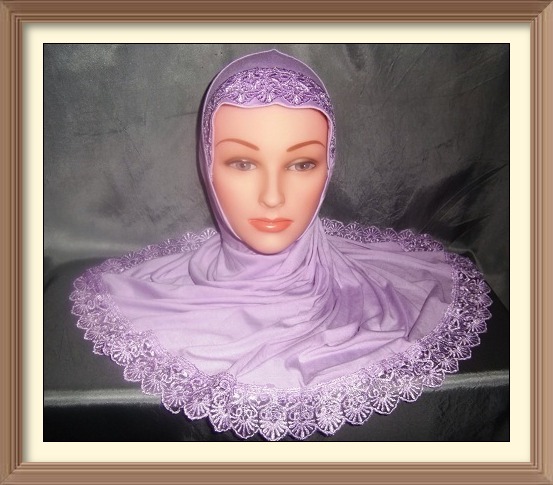
Figure out your style. Hijabs come in many styles. Try pinning or tying your scarf in new ways, or consider one-piece or two-piece pull-on hijabs.


Recognize which colors suit your complexion and eyes, as well as your outfit.However, this does not mean to put on hijabs with bright, vibrant, eye-catching colours. Try avoiding bright pink, red or acid green, etc. Dark brown, grey blue, black is encouraged. Dark and bold colors.Make sure that your understanding of hijab as general modest dress is compatible with the way you dress.


Never try wearing skinny jeans (or anything too tight) with a hijab.Your hijab will end up looking like a big hat on your head and distort your shape.


Wear hijab in combination of colors. For instance, if your dress is yellow then wear some darker color hijab.


You can make your hijab pretty by adding some beautiful pins and ribbons for occasions.It makes the overall look stylish and elegant.


Do not feel shy about new style ideas for wearing hijab. Check the styles on this site for creative approaches to wearing hijab.